- Published on
AI raises the bar on agency for everyone
5 min read - 964 words- Authors

- Name
- Florian Bellmann
As engineers we've been working with AI and spec-driven development workflows for quite a while now. Looking around, the other departments are adopting AI rapidly too. They have less of a technical background, so it naturally takes them a bit longer to get into sophisticated workflows. But they're getting there.
That's only the preamble. I want to make clear that this post is not only about engineering and development.
It's about agency and responsibility, and about the fact that AI raises the bar on both. For everyone.
Overview
The artifact isn't the work anymore
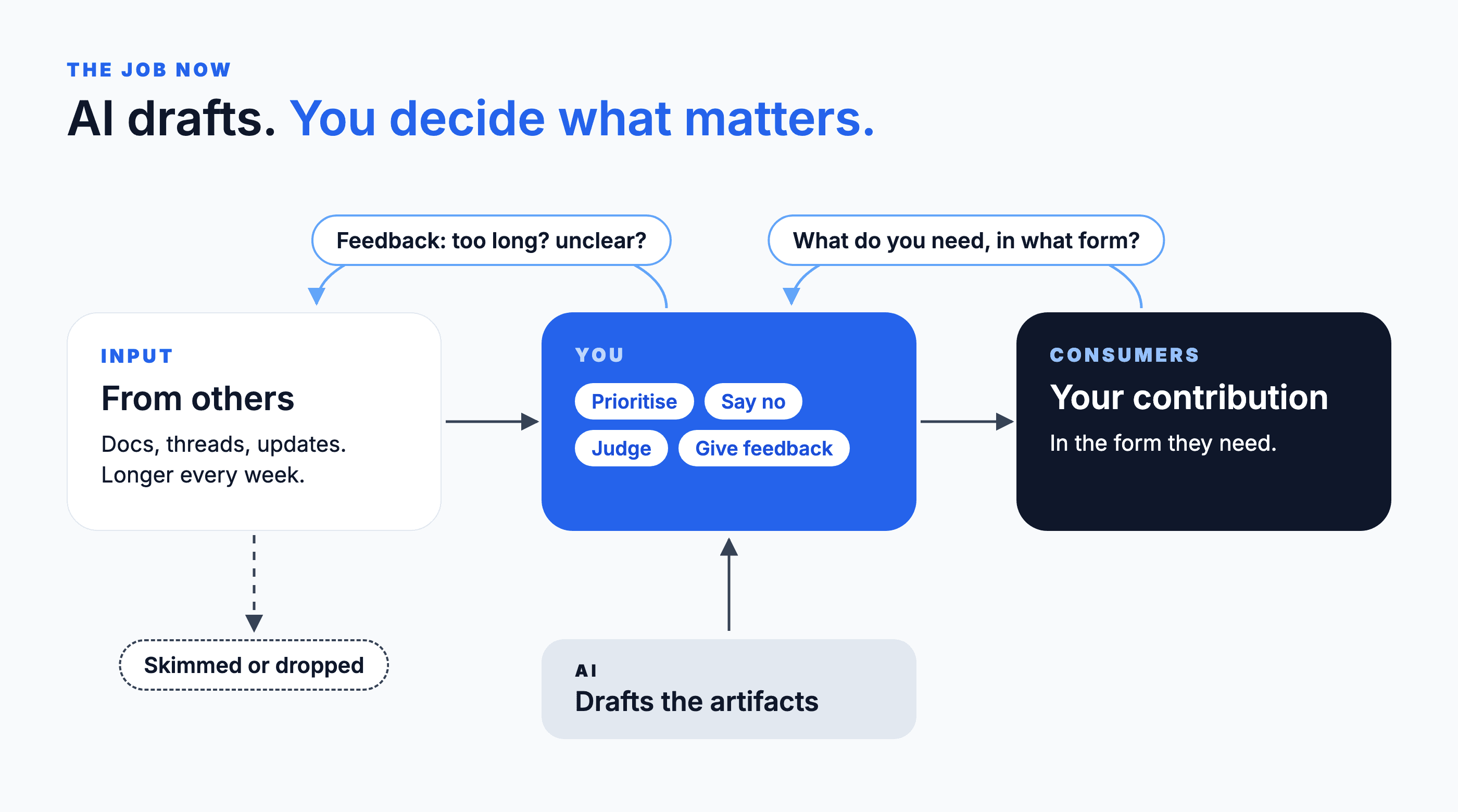
A lot of what we did in the past was about creating artifacts. A document, a spec, a presentation, a piece of code. Many of those tasks are now delegated to AI. What's left is prioritising, saying no, judgment and giving feedback.
I've written about some of this before, mostly about judgment in You are still valuable. Two aspects are new to me here. Giving feedback. And agency in the sense of what you involve yourself with, and at which level of detail.
Deciding what to look at, and how closely, is now part of everyone's job.
Everyone produces more
The sheer volume of output from basically everyone is amplified. The length of every document anyone produces is going up.
So the attention we need to put on those things, and the ability to figure out what the critical parts are, matter a lot more than they used to.
The same goes for asynchronous communication. We can't simply discuss everything the way we did before. If we tried, we'd spend the whole week discussing matters, because everyone is putting out so much.
Curate what you consume
That puts it on everyone, even more than before, to get yourself the context you need to do your job in the best way. Figure out who your stakeholders are and what type of output you consume from others.
- Whose output do I actually need for my work?
- Which documents and channels am I reading, and why?
- Is it too verbose?
- Is it easy to understand?
- Can I find the critical part quickly?
Then give feedback on that output. Tell people when their document is too long or hard to follow. Feedback on what you consume is how you sharpen your own focus and spend your time and attention more effectively.
Most seniors, and most of all managers, already had to do this in the past. Now it's on everyone.
Everyone is an executive now
Peter Drucker wrote The Effective Executive in the sixties. His definition of an executive was never about a title. Any knowledge worker who is responsible for a contribution that materially affects the organisation's ability to perform counts. With AI taking over most of the artifact work, that's basically everyone.
So everyone now has to ask themselves the questions an effective executive asks:
- What's my input?
- Who are my consumers?
- How can I respect everyone's time?
- How do we set up asynchronous ways of working in which everyone is responsible and has high agency?
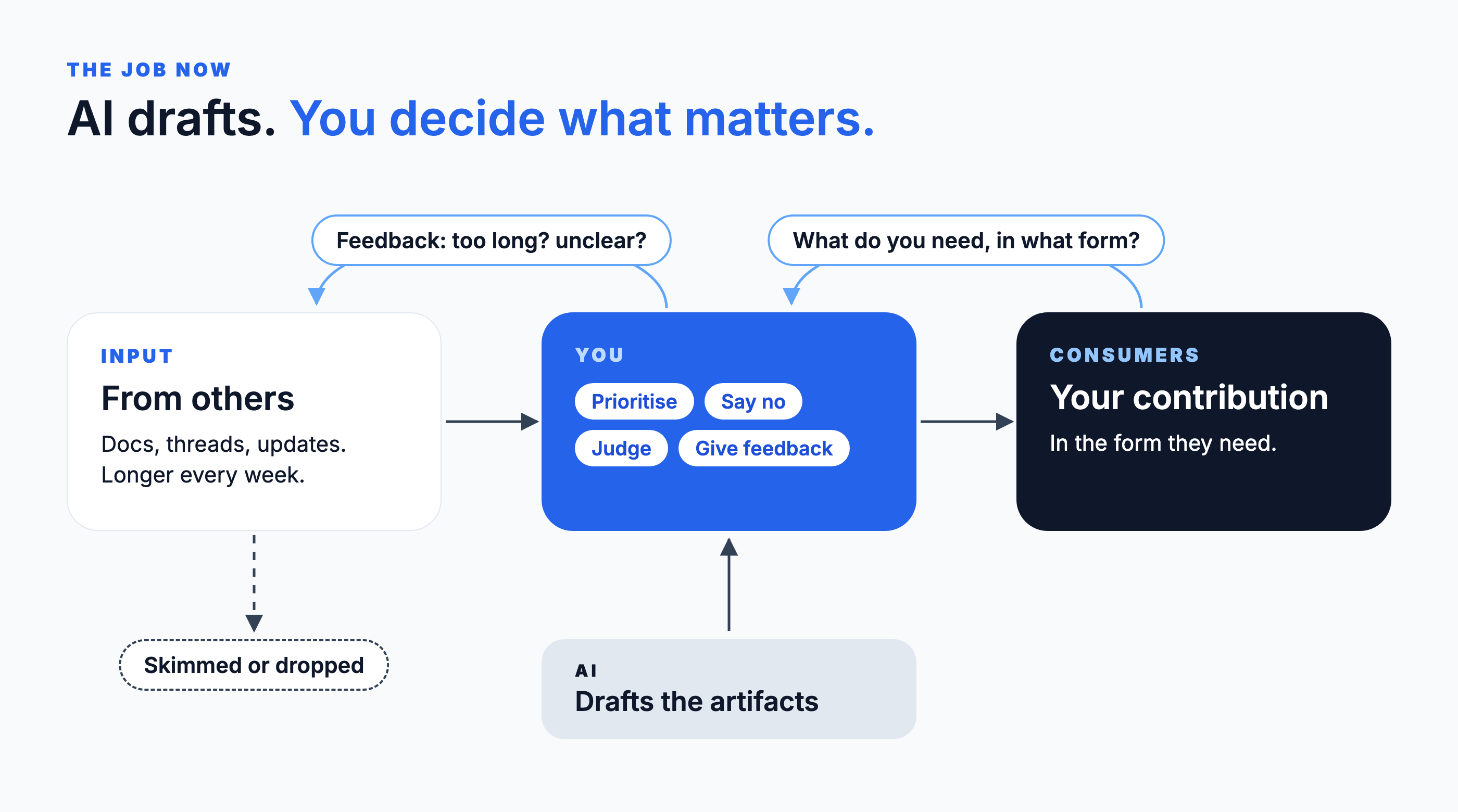
These used to be questions for managers. Now they're everyone's questions.
This is change management
Not everyone will adapt to this naturally, and that's okay. Similar to what I wrote in Nobody knows what to expect from engineers anymore and Processes don't create ownership, people do, I find it hard to say where the responsibility sits.
Part of it is the job market changing. Expectations are rising everywhere, and many people will work their way into it on their own, like they did with every tool shift before.
Part of it is on us as companies. Nourish, foster, educate. Make the new expectations explicit instead of hoping people guess them.
It's a bit of a liberal versus social question and I don't have a clean answer. What I do see is that agency is moving to the centre of most roles. Not because people lacked it before. It just wasn't as central to everything they did.
How to approach it
For yourself
- Track your time for a week and look at where it actually goes.
- Ask the people you work with what they need from you, and in what form. Drucker makes this point in Managing Oneself. Most people never ask, so they're never told.
- Decide what you won't do. Drucker calls these posteriorities. Which channels, meetings and documents you skim or drop.
- Own what AI produces for you before you send it. Put the point, the decision or the ask at the top. Length follows the topic, not the tool.
- Give feedback on the output you consume. Kindly and specifically.
For teams
- Write down your async norms. What goes into a document, what needs a meeting, what a good update looks like.
- Leads model it. If the manager sends ten pages of generated summary, so will everyone else.
- Measure outcomes, not volume. More documents is not more value.
- Make feedback on output normal, in both directions.
Start small
Pick one input you consume every week and one person whose output you depend on. Ask them what they need from you, and tell them what you need from them.
Agency always mattered. It's just a lot more visible now.
Cheers,
Flo